

With marketplace consolidation putting charge point operators under increased business pressure, as well as increasing competition at EV charge point locations, Reuben Elman, infrastructure strategist at Formula Space, talks about how switching to a focus on utilisation rates is driving income and profits.
In the early days of the EV charging rollout, a charge point operator’s plan for growth was very much embedded in total number of connectors: more chargers, more capacity, more sites. It was a reasonable marker of progress and success because the public charging network was genuinely sparse. Filling geographical gaps – getting the first-mover advantage – was a primary goal, particularly in underserved areas.
But in many locations today, the gaps are going - or even gone. Charge point operators now have established networks, and in many cases, charging locations are competitively served by more than one operator. Installing more chargers in already-served locations arguably dilutes revenue across more hardware. New chargers also incur significant capital installation and operational costs, and with current grid constraints, can be slow to roll out.
The conversation so far is hardware. But the opportunity isn't.
Charge point operators are increasingly realising that utilisation – the proportion of time a charger is in active use – is key to business results. And results matter, in a marketplace that is undergoing consolidation amongst its key players, and where investors (and landowners) are increasingly focusing on the return across their installed base.
A charger that sits idle for a significant part of the day isn’t so much a business asset as a liability. Most charge point operators know their utilisation figures, but few are comfortable with them. But luckily, driving utilisation is a challenge that already has a solution.
Fastned is an example people keep returning to. The Dutch operator has more than 400 charging stations across Europe (including 200 in the UK). It improved its financial performance substantially by investing in the quality of its stops as destinations or retail concepts – not through hardware upgrades alone. Better design, better amenities, a more coherent experience: Fastned understands that drivers need drinks, good food and toilet breaks in addition to reliable fast charging. i
Whether consciously or subconsciously, a trouble-free experience and good facilities contribute to drivers choosing a particular location or operator over another: they return more often, increasing utilisation and the return on each charger.
What motorway services figured out decades ago
Despite its very different approach to ‘filling up’, the traditional motorway service station is a useful lens here. So many people choose McDonald's on the road, not for its cuisine but because you can rely on its consistency. You know exactly what you're getting, wherever you are, however tired you are. That predictability drives habitual use, and habitual use drives revenue.
The same logic applies directly to charging networks. A driver who knows what to expect from a brand will chose to route to that network first. They value reliable signage and guidance, accessible facilities, a coherent experience from the approach road to the end of the session – loyalty built not through an app or a scheme, but through the physical experience of the site itself.
It also scales in a way that hardware investment doesn't. A well-designed site with few chargers will consistently outperform a poorly designed site with more. Spending a minimal amount on those nice to haves that make a site usable, allows charge point operators to leverage the most expensive investment, the charger, into quicker returns.
What good actually looks like
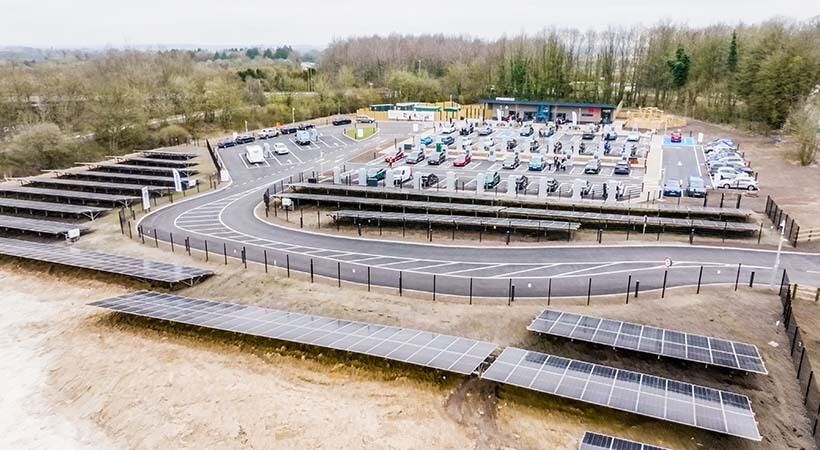
Some of the best examples of well-designed charging sites are already operating in the UK. InstaVolt’s Winchester Superhub and Be.EV’s Manchester Charging Oasis – both sites Formula Space has been involved in delivering – offer a glimpse of what happens when the above-ground experience is treated as seriously as the hardware at its core.
These aren't just charging stops. They're destinations with considered wayfinding, clearly displayed pricing, appropriate shelter, and amenities that make a 20-minute dwell time feel less like a delay and more like a natural pause. Driver behaviour at sites like these tells a consistent story: when the experience is good, people return. When they return regularly, utilisation climbs, without a single additional charger being installed.
Europe has been ahead on this. Charging destinations across the Netherlands, Germany and Scandinavia have long treated the above-ground environment as integral to the commercial proposition. The UK is catching up, but there remains a significant gap between the best and worst sites.
Accessibility is an underrated commercial argument
PAS 1899 is the guidance that covers the design of EV charge points for people with diverse accessibility needs – and operators are expected to comply with it. But where they do, compliance tends to be treated as a basic obligation, which undersells it and the benefits it can bring. Designing sites that work genuinely well for drivers with disabilities, for families, or for older drivers, expands the addressable market – and can also improve the experience for people outside of these categories, too.
The M&A moment nobody's making the most of
The EV charging sector is consolidating quickly. Networks are being acquired, rebranded, and rationalised. And yes, at its core, these changes tell a financial or business-centred story. But it’s also something more valuable: a reset moment. When a site changes hands and takes on a new brand, there is a natural opportunity to ask not just what the new brand colours should be, but what the experience actually delivers, and the improvement that could drive utilisation.
Designing sites to drive utilisation does require a change of approach for charge point operators. But as the market is already seeing, with the right support and expertise, the rewards can be significant.
For more information about Formula Space’s EV charging site design and infrastructure solutions, visit https://formula-space.com