

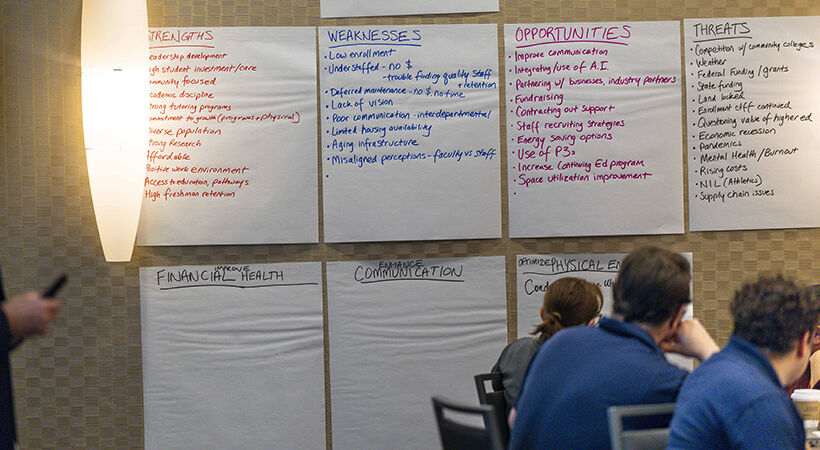
Lindsay Wagner, PhD asks, what role does the health of organizational culture play in the cost to maintain and operate educational facilities?
I frequently work with university facilities management departments that was struggling to control their deferred maintenance backlog. The leadership teams have tried everything — new software, restructured work orders, additional budget appeals. What they haven't tried is looking inward. What they haven't examined is their culture.
The question I want to explore in this article is one that doesn't often find its way into budget meetings or capital planning sessions: Is organizational culture affecting the bottom line? More specifically, is there a relationship between the health of an organization's culture and the cost to maintain and operate educational facilities? I believe the answer is yes — and I believe the evidence is hiding in plain sight.
The hidden variable in facilities cost
Facilities managers are well-acquainted with the tangible drivers of operational cost: aging infrastructure, deferred maintenance, energy inefficiency, labor rates, and material costs. These variables are measurable, reportable, and defensible in front of a budget committee. Culture, on the other hand, is not something that appears on a balance sheet. And yet, culture quietly influences nearly every line item.
Consider what happens in an organization where trust is low. Work orders sit longer than they should because technicians are uncertain about expectations or fear making mistakes without backup. Preventive maintenance gets deferred — not for budget reasons, but because the team lacks the psychological safety to flag problems before they become emergencies. Small issues become expensive ones. What looks like a maintenance failure is often a culture failure.
Now consider the cost of turnover. According to research in the human capital space, replacing a single employee can cost anywhere from 50 to 200 percent of that employee's annual salary when you account for recruitment, onboarding, lost institutional knowledge, and reduced productivity during the transition. In educational facilities — where trades knowledge is highly specialized and institutional memory is invaluable — turnover is extraordinarily expensive. And what drives turnover? In most cases, it isn't compensation. It is culture.
Culture as an operational variable
When I work with facilities organizations on culture transformation, I often ask leadership to think of culture not as a soft concept, but as an operational variable. Like humidity affects a building's envelope, culture affects the efficiency and reliability of everything inside an organization. A toxic or fragmented culture creates friction — and friction has a cost.
Friction shows up as redundant work when communication breaks down between trades. It shows up as equipment failures that were reported but never addressed because the person who flagged the issue didn't feel heard. It shows up as absenteeism, presenteeism, and the quiet disengagement of people who have stopped trying. It shows up in the slow deterioration of a building whose caretakers no longer feel a sense of ownership or pride.
Belonging — the feeling that one is valued, included, and connected — is not a luxury in the workplace. It is a precondition for engagement. And engagement is directly correlated with performance. When facilities employees feel a genuine sense of belonging, they are more likely to take initiative, report problems early, care for equipment properly, and collaborate across teams. All of these behaviors reduce operational costs. Their absence inflates them.
The data we aren't collecting
One of the challenges in making the case for culture investment is that most facilities organizations are not measuring the right things. We measure response times and completion rates. We measure preventive maintenance compliance and work order aging. We measure square footage per employee and cost per square foot. What we rarely measure is the human capital health of the organization — and without that data, we cannot draw the connections that would make the cost of culture visible.
Imagine, for a moment, what it would look like to overlay employee engagement data with operational performance data over time. If we could correlate periods of low morale with spikes in reactive maintenance, or periods of high turnover with increases in emergency repairs, we would begin to see culture not as an HR concern but as a facilities management concern. We would start to see that investing in people is not separate from investing in buildings — it is the same investment.
What culture health looks like in practice
Healthy organizational culture in a facilities context is not about ping pong tables or free lunches. It is about clarity, trust, respect, and belonging. It is about a custodian who feels comfortable telling their supervisor that a particular cleaning protocol isn't working. It is about a plumber who takes pride in the craftsmanship of their repairs because they feel that pride is noticed and valued. It is about a project manager who collaborates openly with their counterpart in another department rather than guarding territory.
These behaviors compound. They create organizations that respond to problems faster, make better decisions with the information available to them, and sustain institutional knowledge over time. They create organizations that are simply less expensive to operate — not because they cut corners, but because they cut waste.
The question worth asking
The next time your department is asked to justify a budget increase or explain a cost overrun, I encourage you to ask a different question. Don't just ask where the money went. Ask what conditions allowed costs to get out of hand in the first place. Ask whether your team has the clarity, trust, and sense of belonging they need to do their work well. Ask whether your culture is an asset or a liability.
The cost of a healthy culture is real and it is worth measuring. But the cost of an unhealthy one is higher — and it is already showing up in your budget. We just haven't been looking for it in the right place.