

New research by Energy Systems Catapult identifies the innovations needed to unlock a £70 billion opportunity for the UK. Achieving the UK government’s Net Zero targets at least cost hinges on the high use of renewables, nuclear, and crucially innovations that enable flexibility.
Technologies with the potential to provide this flexibility at scale include electric vehicles (EVs), heat stores and static batteries, hydrogen storage, and digital services and consumer propositions that coordinate and control the storage and release of energy in an increasingly decentralised approach.
The Innovating to Net Zero 2026 report modelled and assessed four future scenarios for the energy system to understand how variation in energy generation and demand might evolve depending on uptake of new low carbon and flexible technologies.
It has identified five peaks gaps in energy supply and demand that will shape the overall scale and architecture of the UK’s cleaner energy system, and the innovations in flexibility technologies and services needed to manage them and unlock opportunities for UK businesses and consumers. The market for flexibility in Europe is expected to reach €12 billion a year by 2030.
Guy Newey, CEO of Energy Systems Catapult, said: "Embracing flexibility could help the UK save billions in infrastructure costs – while giving homegrown innovators a platform to scale up and compete globally."
The findings are based on the Catapult’s internationally peer-reviewed Energy System Modelling Environment models – ESME and ESME Flex – the UK’s leading techno-economic whole system models. The Catapult has published an interactive dashboard for users to explore its scenarios and the energy systems data behind them4.
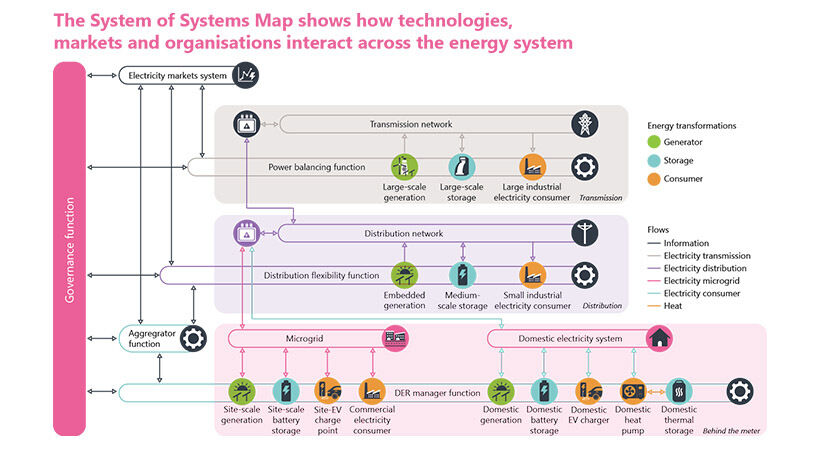
The Catapult has also created a System of Systems Map to help innovators visualise how technologies, markets and organisations interact across the energy system and the information flows between them, allowing more effective solutions to be developed to coordinate and enable system operation.
Driving cost out of the energy system is essential if we are to transition to a cleaner energy system at the pace and scale needed, while maintaining political consensus for action on climate change.
As more renewable capacity comes online and transport and heating become increasingly electrified (through the growing use of EVs and heat pumps) one of the biggest innovation challenges faced is how to balance the energy system when renewable generation is low and demand is high.
The Catapult’s report shows this is where flexible solutions come in. Commercial and domestic technologies and services are needed that store surplus energy and release it to the grid to smooth out peaks in power and heat demand.
Unlocking the potential of flexibility is therefore an urgent priority to help balance supply and demand in near real-time, and help UK businesses capture the growing commercial opportunities in national and international markets.
ESME and ESME Flex modelled four scenarios to understand what effect different versions of the future energy system have on ‘peak gaps’ in supply and demand, and hence the future needs and market opportunities for flexibility.